There isn’t one right way to publish a book in 2026. The best path depends on whether you prioritize creative control, speed, professional support, upfront costs, or access to traditional publishing.
Traditional publishing can provide editorial, production, and distribution support, while self-publishing gives authors greater control over their timeline, pricing, design, and publishing decisions.
Whether you want to work with a traditional publisher or release your book independently, you need a finished manuscript, professional editing, a strong cover, proper formatting, distribution, and a plan for reaching readers. Book publishing services can also help authors handle professional editing, design, formatting, printing, and distribution when they do not want to manage every step alone.
In this guide, you will learn how to publish a book in 2026, how traditional and self-publishing work, what happens after an agent or publisher says yes, what happens after you upload to KDP, how much publishing can cost, how long it can take, and how to prepare your book for launch.
How to Publish a Book: Choose the Right Publishing Path
Before you start sending your manuscript anywhere, decide which publishing path fits your goals. Most authors choose between traditional publishing and self-publishing, but the better option depends on what you value most.
Traditional publishing usually involves submitting your book to literary agents or publishers. If an agent represents you and finds a publisher, the publishing company may handle editing, production, distribution, and other parts of the publishing process.
Self-publishing gives you much more control. You can choose your editor, cover designer, formatter, publication date, price, and distribution options. Platforms such as Amazon KDP allow authors to publish ebooks and print books without maintaining physical inventory.
The important point is that neither route is automatically better.
A useful way to decide is to ask:
- How much creative control do I want?
- How quickly do I want the book available?
- Can I manage or fund professional production?
- Do I want to build an independent publishing business?
- How much responsibility do I want for marketing and distribution?
- Am I comfortable negotiating publishing rights?
- Do I want to pursue the traditional publishing route even if it takes longer?
Traditional Publishing vs. Self-Publishing
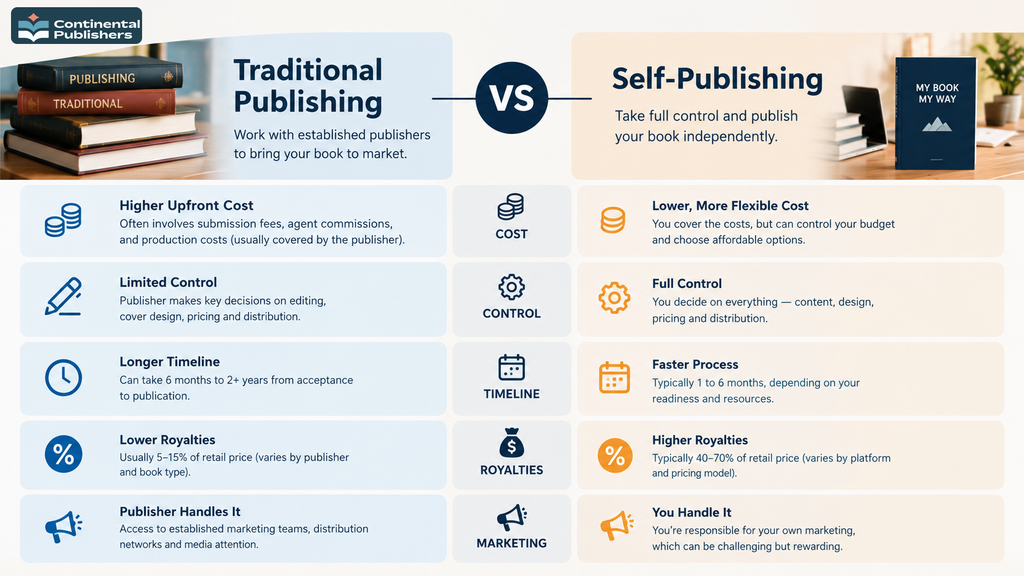
| Factor | Traditional Publishing | Self-Publishing |
| Upfront production costs | Usually covered by publisher | Usually paid by author |
| Creative control | Shared with publisher | Mostly controlled by author |
| Editing | Usually provided by publisher | Author hires or manages editor |
| Cover design | Publisher generally handles it | Author chooses designer |
| Publishing timeline | Often longer | Usually faster |
| Distribution | Publisher manages distribution | Author selects platforms/distributors |
| Royalties | Usually a smaller percentage of the book’s sale price | Potentially higher per sale |
| Marketing | Shared responsibility | Mostly the author’s responsibility |
| Rights | Defined by contract | Author generally retains more control |
| Best for | Authors seeking industry support | Authors seeking control and flexibility |
These are general differences rather than guarantees. Individual contracts and publishing arrangements can vary considerably.
Which Publishing Path Is Right for You?
Use your priorities rather than the perceived prestige of either option.
| If your priority is… | Consider… | Why |
| Maximum creative control | Self-publishing | You make most production and publishing decisions |
| Faster publication | Self-publishing | You control the production schedule |
| Traditional industry support | Traditional publishing | A publisher provides editorial and production support |
| Keeping greater control of pricing | Self-publishing | You generally have more direct pricing control |
| Avoiding upfront production costs | Traditional publishing | Standard production costs are normally handled by the publisher |
| Building an independent publishing business | Self-publishing | You retain greater control over the publishing operation |
| Established distribution support | Traditional publishing | Publishers may have existing retailer and distributor relationships |
| Choosing your own professionals | Self-publishing | You can select your editor, designer, formatter, and other providers |
If you are still deciding how do I publish a book, start with these trade-offs rather than choosing a route simply because it sounds easier.
How Do You Get a Book Published Through Traditional Publishing?
If you want a traditional publishing deal, the process usually begins with preparing your manuscript and researching the right agents or publishers.
For fiction, agents generally want to see a completed manuscript before considering representation. Nonfiction can work differently, with some agents and publishers considering a proposal before the full manuscript is finished.
So, how do you get a book published through the traditional route?
You generally need:
- A strong manuscript or nonfiction proposal.
- A targeted list of literary agents or appropriate publishers.
- A professional query package.
- A submission strategy that follows each recipient’s guidelines.
- Patience during the querying and acquisition process.
Getting an agent is only one stage. The agent may still need to revise the manuscript with you, submit it to publishers, negotiate an offer, and help you evaluate the resulting contract.
1. Finish and Polish Your Manuscript
Do not rush to submit a first draft.
For fiction, this usually means completing the full manuscript before querying. For nonfiction, the requirements can vary, and a strong book proposal may be more important than completing the entire manuscript before approaching agents.
Read your manuscript several times with different goals.
Look for:
- Story or structural problems
- Unclear sections
- Repetition
- Weak transitions
- Inconsistent characters
- Unsupported claims
- Unnecessary words
- Pacing problems
- Gaps in research
A useful test is to ask someone unfamiliar with the project to explain what they think the book is about after reading the opening chapters. If their interpretation differs significantly from your intended positioning, the manuscript may need more work.
2. Research Literary Agents
If your book requires an agent, research agents who represent your genre and type of book.
Do not send the same generic query to everyone.
Study:
- Submission guidelines
- Genres represented
- Current clients
- Recent deals
- Publisher relationships
- Whether the agent is currently accepting submissions
- Whether the agent requests a full manuscript, sample chapters, synopsis, proposal, or other materials
An agent who represents children’s fiction may not be interested in a business book, just as a nonfiction agent may not be the right person for a fantasy novel.
3. Prepare Your Query Package
Your query package may include:
- Query letter
- Synopsis
- Sample chapters
- Book proposal
- Author biography
- Platform information
- Other materials requested by the agent
Your query should quickly explain what makes the book interesting, who the target reader is, and why you are the right author to write it.
4. Submit and Be Patient
Traditional publishing can take time.
Agents receive large numbers of submissions, and a rejection does not automatically mean your book is bad.
Track your submissions in a simple spreadsheet or document. Record:
- Agent
- Agency
- Date submitted
- Materials requested
- Response
- Follow-up date, if appropriate
- Notes about the agent’s preferences
Follow the requested guidelines rather than trying to persuade an agent to accept materials they specifically said they do not want.
What Happens After an Agent Says Yes?
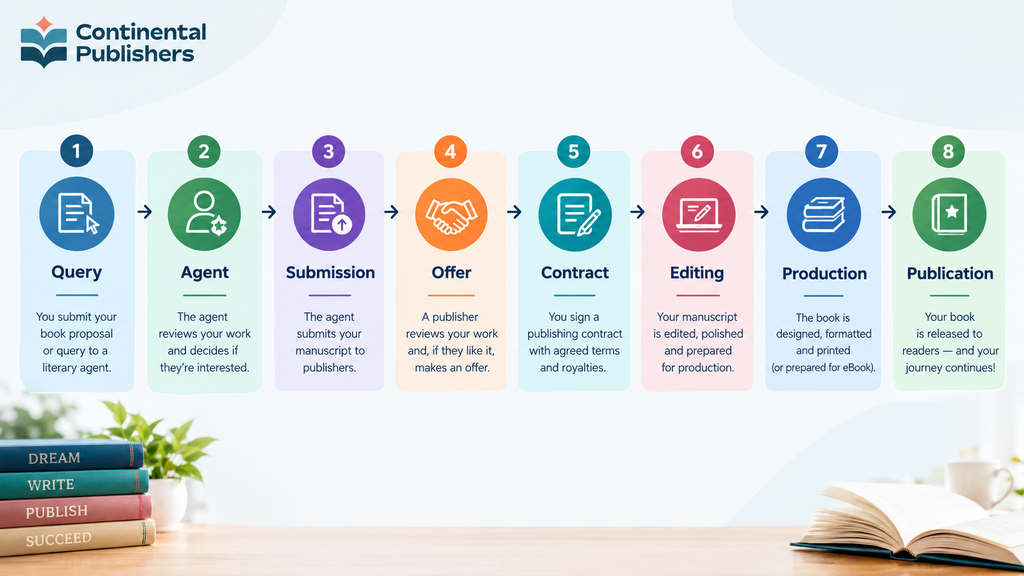
Getting an agent is an important milestone, but it does not mean your book will immediately appear in stores.
The agent may first discuss revisions with you and prepare the manuscript for submission. They then approach suitable editors and publishing houses.
If an editor becomes interested, the publisher may evaluate the project internally before making an offer.
The general journey looks like this:
Query → Agent representation → Manuscript preparation → Publisher submission → Editor interest → Offer → Contract → Editorial work → Production → Distribution → Publication
If more than one publisher is interested, your agent may negotiate the deal and help you compare offers.
Once you accept a contract, the manuscript enters the publisher’s production process.
This distinction matters because agent representation and a publishing deal are separate milestones.
How Do I Publish a Book Independently?
Self-publishing removes the need to convince a traditional publisher to accept your manuscript. However, it does not remove the need for professional publishing standards.
If you choose this route, you become responsible for important decisions about:
- Production
- Pricing
- Distribution
- Marketing
- Metadata
- Rights
- Retail platform
- Book formats
- Launch timing
Here is how to publish a book independently from manuscript to finished product.
Step 1: Complete and Revise the Book
Your first draft is not the finished product.
Start with your own revisions, then consider getting feedback from beta readers or a critique group.
Ask readers to identify:
- Confusing sections
- Slow sections
- Repetitive passages
- Underdeveloped characters or arguments
- Missing information
- Places where they stopped reading
- Questions that remained unanswered
A professional editor can then help you take the manuscript further.
Step 2: Hire the Right Type of Editor
Different editing stages solve different problems.
- Developmental editing: Looks at structure, pacing, characters, argument, organization, and big-picture issues.
- Line editing: Improves clarity, flow, word choice, and sentence construction.
- Copyediting: Checks grammar, spelling, consistency, punctuation, and usage.
- Proofreading: Finds remaining errors after the book has been formatted.
You may not need every service for every book.
For example, a heavily researched nonfiction book may need substantial developmental and copyediting work, while a polished short novel may require a different combination of services.
The goal is not to buy every possible editing service. The goal is to identify the problems your manuscript actually has and hire the appropriate professional to solve them.
Step 3: Create a Professional Book Cover
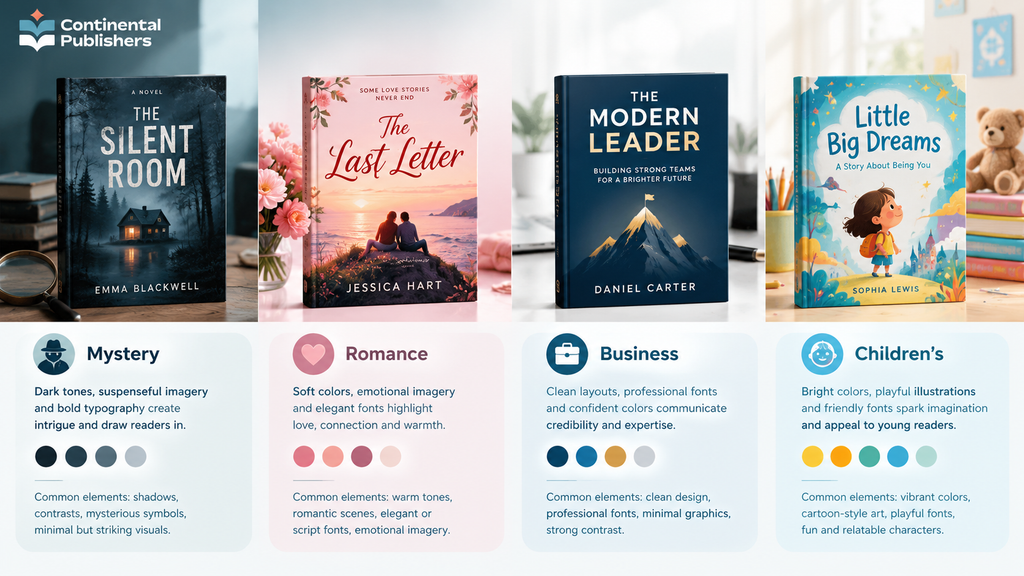
Your cover is one of the first things potential readers see.
A good cover should communicate the book’s genre and tone while remaining easy to recognize as a thumbnail.
A mystery novel, romance, business book, and children’s book should not all use the same visual approach.
When deciding how to publish book projects professionally, remember that design is not simply decoration. Your cover is part of your book’s positioning and sales strategy.
A Practical Cover Research Exercise
Before briefing a designer:
- Find 15–20 successful recent books in your genre.
- Look at them as thumbnail images rather than full-size covers.
- Record recurring colors, typography, imagery, layouts, and visual themes.
- Identify which conventions communicate the genre immediately.
- Note which covers look distinctive without appearing unrelated to the category.
- Give your designer this research as context rather than asking them to copy another book.
This approach gives the designer useful market information while leaving room for an original design.
Step 4: Format the Interior
Your manuscript must be formatted correctly for every edition you plan to release.
An ebook requires a different approach from a paperback or hardcover.
Pay attention to:
- Headings
- Spacing
- Page breaks
- Fonts
- Images
- Tables
- Margins
- Front matter
- Back matter
- Chapter openings
- Page numbering
- Links and navigation in ebooks
Always check the final files on multiple devices when possible.
For print books, ordering a physical proof can reveal problems that are difficult to notice on a computer screen.
Step 5: Choose Your ISBN and Publishing Details
Depending on your country and publishing method, you may need ISBNs for different formats or editions.
The International ISBN Agency explains that different formats, languages, and editions generally require separate ISBNs, and publishers should obtain ISBNs through the national ISBN agency where they are based.
You should also prepare essential book information such as:
- Book title and subtitle
- Author name or pen name
- Book description
- Categories
- Keywords
- Author biography
- Copyright page
- Price
- Trim size
- Publication date
- Publisher or imprint information
ISBN vs. Copyright: What Is the Difference?
An ISBN identifies a publication; it is not the same thing as copyright protection.
For example, the U.S. Copyright Office explains that copyright protection in the United States exists automatically when an original work is fixed in a tangible form. Registration is separate and provides additional legal benefits in the U.S.
Because copyright rules differ by jurisdiction, international authors should check the requirements that apply in their country.
The important distinction is simple:
ISBN = identifies a publication.
Copyright = protects qualifying original expression.
How to Publish Books on Amazon and Other Platforms
Once your manuscript, cover, and metadata are ready, choose where readers will buy your book.
Amazon KDP is one of the best-known self-publishing platforms. Authors can upload book files, select formats, set prices, and publish through the platform.
KDP also supports print-on-demand, meaning books can be printed when customers order them rather than requiring the author to hold a large inventory.
For ebooks, KDP has different royalty options and eligibility rules.
Amazon’s current U.S. pricing information states that, effective July 7, 2026, the 70% royalty option for Amazon.com ebooks has a $2.99–$12.99 list-price range. The 70% option also has additional eligibility requirements, and delivery costs can apply.
This is why authors should never assume that a published book automatically earns a fixed percentage.
Royalty calculations can depend on:
- Format
- Territory
- List price
- Royalty option
- Delivery costs
- Printing costs
- Distribution choices
- Other platform-specific requirements
Always check the current platform rules before setting your final price.
What Happens After You Upload Your Book to KDP?
Uploading your files is not necessarily the final step.
After submission, KDP reviews the book and its publishing information. Once the book is approved, it can become available according to the release settings you selected.
Before launch, review the live product information carefully.
Check:
- Title
- Subtitle
- Cover
- Description
- Author name
- Categories
- Keywords
- Pricing
- Available formats
- Publication date
For print books, reviewing a proof copy can also help identify formatting or production problems.
The process is essentially:
Upload → Review → Approval → Product page → Proof/check → Publication → Sales and royalty reporting
KDP continues to update its tools and requirements, so authors should check the official KDP Help pages when publishing or changing a book.
Think Beyond a Single Store
You can also consider other distribution options depending on your goals.
Some authors prefer to sell directly through their own websites, while others use distributors to reach bookstores, libraries, or international markets.
The important question is not simply where you can upload your book.
Ask:
Where do my target readers actually buy books?
And:
How much distribution management am I willing to handle?
A single-platform strategy can be easier to manage. A wide-distribution strategy can provide access to additional retailers and channels but usually requires more metadata, pricing, reporting, and platform management.
Ready to Take the Next Step?
From editing and professional book design to formatting and distribution, the right publishing support can make the process easier and more professional. Explore our book publishing services to see how we can help bring your book from manuscript to market.
What Does “Wide Distribution” Mean?
Wide distribution means making a book available through multiple retailers, platforms, libraries, bookstores, or distribution channels rather than concentrating on one exclusive ecosystem.
For ebooks, going wide can mean distributing through multiple eligible retailers.
For print books, distribution can involve wholesalers and services that make titles available to bookstores and libraries.
Wide distribution can increase potential reach, but it also creates more platforms, metadata requirements, pricing considerations, and reporting to manage.
KDP Select vs. Going Wide
KDP Select is an optional 90-day program for eligible Kindle ebooks. During the enrollment period, the ebook must remain exclusive to KDP for digital distribution, although authors can continue distributing print, audio, and other non-digital formats elsewhere.
Going wide takes a different approach by making the ebook available through multiple eligible retailers or channels.
| If you want… | Consider… |
| A simpler Amazon-focused strategy | KDP Select may be worth considering |
| Broader ebook retailer availability | Going wide |
| Greater distribution flexibility | Going wide |
| Amazon-specific promotional opportunities | KDP Select may be useful |
| Less platform management | A more concentrated strategy |
Neither strategy is automatically better.
The right choice depends on your audience, goals, and willingness to manage multiple sales channels.
How to Publish a Book with a Publisher: What Authors Should Know
If your goal is to work with a traditional publisher, you should understand what happens after an offer is made.
Authors sometimes focus heavily on the advance and overlook other parts of the contract.
Before signing, review issues such as:
- Royalties
- Rights
- Territories
- Formats
- Audio rights
- Translation rights
- Delivery requirements
- Termination provisions
- Rights reversion
- Publication deadlines
- Marketing obligations
Learning how to publish a book with a publisher is not only about getting an offer. It is also about understanding what you are agreeing to when you sign a publishing contract.
What Happens After a Publisher Acquires a Book?
Once a publisher acquires your book, it normally moves through several production stages.
- Editorial development: An editor may work with you on structure, clarity, pacing, organization, or other improvements.
- Copyediting: The manuscript is checked for grammar, punctuation, consistency, style, and factual or internal inconsistencies.
- Proofreading: Final errors are checked after the book has been prepared for production.
- Cover and interior production: The publisher coordinates the visual presentation of the book, although the author’s level of creative input varies.
- Proofing and production: Final files are prepared for the selected formats.
- Distribution: The finished book is supplied through the publisher’s chosen retail and distribution channels.
- Publication: The book becomes available according to the publisher’s planned release schedule.
Before signing, remember that publishing agreements can affect your book for years.
The Authors Guild highlights the importance of rights-reversion and out-of-print provisions because these clauses can determine when authors can regain rights to their work.
Consider qualified legal advice before signing an agreement you do not fully understand.
What Should Authors Look for in a Publishing Contract?
Pay particular attention to:
- Rights: What rights are you granting?
- Territories: Which countries are covered?
- Formats: Does the agreement include ebook, print, audiobook, or other formats?
- Royalties: How are royalties calculated?
- Advance: What is the advance, and how is it paid?
- Subsidiary rights: Who controls translation, audio, film, or other rights?
- Publication deadline: When must the publisher release the book?
- Marketing obligations: What does the publisher actually promise to do?
- Termination: Under what circumstances can the agreement end?
- Rights reversion: When can rights return to the author?
Do not judge an offer solely by the size of the advance.
For example, a contract with a larger advance may still deserve careful scrutiny if it grants broad rights for a long period or contains unfavorable reversion provisions.
Rights, obligations, royalties, territories, and termination terms can be just as important as the headline advance.
How Much Does It Cost to Publish a Book?
The cost depends heavily on your publishing route, book length, genre, production requirements, and the quality of professional services you use.
If you choose to work with a book publishing company, your overall investment may include services such as editing, cover design, formatting, printing, distribution, and marketing, depending on the package you select.
Traditional publishing generally does not require the author to pay normal publishing production costs in the same way self-publishing does. However, self-publishing can involve expenses for:
- Developmental editing
- Copyediting
- Proofreading
- Cover design
- Interior formatting
- ISBNs
- Illustrations
- Printing
- Audiobook production
- Website development
- Advertising
- Book marketing
Self-Publishing Cost Planning
There is no universal price list for professional publishing services.
Instead of treating a single set of figures as industry-standard prices, build your budget around the services your particular book needs.
For example:
| Service | What affects the cost |
| Developmental editing | Word count, manuscript condition, complexity, editor experience |
| Copyediting | Word count, subject complexity, manuscript quality |
| Proofreading | Word count, formatting, number of corrections required |
| Professional cover design | Genre, designer experience, complexity, illustration requirements |
| Interior formatting | Print dimensions, images, tables, illustrations, ebook complexity |
| Audiobook production | Narration, recording, editing, mastering, production model |
| Initial marketing | Advertising budget, creative assets, audience size, campaign length |
This approach is more useful than assuming every book should cost the same amount.
You do not necessarily need to spend thousands of dollars on every service.
The important thing is to spend money where it improves the reader’s experience and professional quality.
A Practical Publishing Budget
Before hiring anyone, divide your budget into three categories:
Essential
- Editing appropriate to the manuscript
- Professional cover
- Correct formatting
- Proofreading
- Required publishing/distribution costs
Optional
- Audiobook
- Website
- Additional illustrations
- Professional photography
- Advanced advertising
Growth
- Advertising campaigns
- Promotional services
- Events
- Publicity
- Additional content and audience-building activities
This prevents authors from spending their entire budget on production while leaving nothing for reaching readers.
Turn Your Manuscript Into a Finished Book
Professional editing, cover design, formatting, and publishing support can help you avoid costly mistakes and create a book that is ready for readers. See how our publishing services can support your project from start to finish.
Get Your Book PublishedHow Long Does It Take to Publish a Book?
The timeline depends on the publishing route and how much work the manuscript needs.
The following is an illustrative planning timeline, not a guaranteed industry schedule:
| Stage | Illustrative planning range |
| Self-revision | 2–8 weeks |
| Developmental editing | 4–12 weeks |
| Copyediting | 2–6 weeks |
| Cover and interior design | 2–6 weeks |
| Proofreading and corrections | 1–3 weeks |
| Final self-publishing preparation | 1–4 weeks |
| Traditional querying | Several months to 1+ year |
| Traditional production after acquisition | Often 12–24+ months |
These ranges can overlap.
For example, cover research and design can begin while final editorial work is underway, while proofreading generally comes after the manuscript has been finalized and formatted.
A complex illustrated book can take much longer, while a short, polished manuscript may move faster.
Traditional publishing generally takes longer because the author must account for querying, representation, acquisition, editorial work, production, and the publisher’s release schedule.
How Do I Publish a Book That Readers Actually Want?
Publishing the book is only half the job.
A technically perfect book can still struggle if readers do not know it exists or if its positioning does not match what they are looking for.
Before publication, start thinking about your audience.
Ask:
- Who is this book for?
- What problem does it solve?
- What emotion does it create?
- What books will readers compare it with?
- Where do those readers spend time?
- Why should someone choose this book instead of another?
Your answers can guide your:
- Cover
- Description
- Keywords
- Categories
- Pricing
- Launch strategy
- Promotional content
Research Comparable Books
One of the simplest ways to improve positioning is to study books competing for the same readers.
Choose around 10–20 recent comparable titles and record:
- Title
- Subtitle
- Genre/category
- Cover style
- Price
- Description length
- Description structure
- Review count
- Common themes
- Frequently used keywords
- Format availability
You are not trying to copy these books.
You are trying to understand reader expectations and identify opportunities to position your book clearly.
Build an Author Platform
An author platform does not mean you need millions of followers.
It can be a simple combination of:
- Author website
- Email list
- Social media presence
- Professional network
- Podcast appearances
- Guest articles
- Existing community
- Reader groups
The goal is to build a way to communicate with potential readers before and after your book launches.
Choose the Platform That Fits Your Audience
A fiction author may focus on reader communities, newsletters, and genre-specific platforms.
A nonfiction author may benefit more from LinkedIn, professional associations, speaking opportunities, podcasts, and an email newsletter.
An author who already has an established audience can use that audience to support preorders, launch announcements, and future releases.
The objective is not to be everywhere.
It is to build a repeatable way to reach the people most likely to care about your books.
How Bookstore Distribution Actually Works
Publishing a book online does not automatically put it on bookstore shelves.
Bookstores need a practical way to order, receive, sell, and account for books.
For independently published books, distribution services can make ordering easier for booksellers and libraries.
IngramSpark’s current guidance says that a 53%–55% wholesale discount combined with returnable status generally allows the widest availability through many retailers and bookstores, although it explicitly notes that there is no guarantee that a particular retailer will purchase or stock a book.
IngramSpark also notes that bookstores commonly expect books to be returnable because unsold inventory can otherwise create financial risk for the retailer.
That means there is an important difference between:
“A bookstore can order my book” and “My book is physically stocked on the bookstore’s shelf.”
Authors seeking physical bookstore placement should consider:
- Professional cover design
- Appropriate trim size
- Wholesale discount
- Returnability
- Distribution availability
- Local bookstore relationships
- Author events
- Retailer demand
- Pricing
- Local outreach
- Marketing support
Distribution makes the book available to order. It does not guarantee that a bookstore will decide to stock it.
Prepare Your Book Launch
A launch plan might include:
- Creating a preorder when appropriate.
- Preparing your book description.
- Collecting advance reviews where permitted.
- Creating social media content.
- Contacting relevant blogs, podcasts, and publications.
- Preparing launch-day emails.
- Planning promotional pricing when appropriate.
- Monitoring sales and reader response.
The most important principle is to match the launch to your audience.
A debut fiction author with no established audience should not necessarily use the same launch strategy as a business author with an existing professional network.
A Realistic Book Launch Timeline
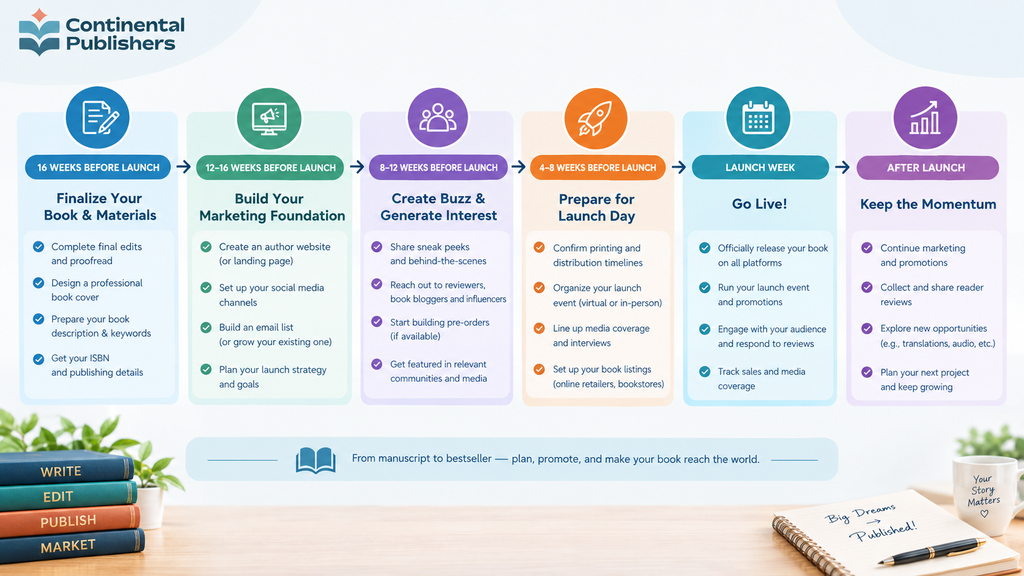
12–16 weeks before launch
- Finalize editing
- Complete cover and interior design
- Prepare your author platform
- Begin launch planning
- Identify relevant reviewers, podcasts, newsletters, or publications
8–12 weeks before launch
- Prepare retailer pages
- Finalize metadata and book description
- Begin outreach to reviewers and relevant media
- Prepare promotional content
- Build your launch email sequence
4–8 weeks before launch
- Review final files
- Order a print proof if applicable
- Prepare email and social campaigns
- Confirm launch pricing
- Test links and retailer pages
Launch week
- Publish the book
- Send launch communications
- Promote through your selected channels
- Monitor technical issues and reader response
- Make sure retailer information is displayed correctly
After launch
- Continue marketing
- Monitor sales
- Improve metadata or positioning where appropriate
- Build your audience for the next book
- Document what worked and what did not
Marketing should not begin the day your book is published.
Give yourself enough time to build awareness and create assets before launch day.
Common Mistakes to Avoid When Publishing a Book
Knowing how to publish book successfully also means knowing what can go wrong.
Publishing an Unedited Manuscript
Readers notice obvious mistakes quickly.
Professional editing can improve clarity, structure, consistency, and credibility.
Using Friends as Your Only Editors
Friends and family can provide valuable feedback, but they may not identify the same structural, stylistic, or technical problems that a professional editor will catch.
Use friends as readers and sources of feedback, but understand what type of review your manuscript actually needs.
Using a Generic Cover
Your cover is part of your marketing.
A weak or confusing design can make readers skip your book before they ever read the description.
Publishing Before You Are Ready
A faster publication date is not useful if the manuscript still needs major revisions or the production files contain errors.
Ignoring Print Proofs
What looks correct on a screen can sometimes look different in print.
A physical proof can reveal spacing, image, margin, color, or production problems before customers receive the book.
Ignoring Metadata
Your title, subtitle, description, categories, and keywords help readers discover your book.
Treat them as part of the publishing strategy, not as paperwork.
Expecting Amazon to Find Your Readers
Uploading a book makes it available; it does not guarantee that your target audience will discover it.
Positioning and marketing still matter.
Signing a Contract Without Understanding Your Rights
An attractive advance does not automatically make a contract favorable.
Understand the rights, territories, formats, royalties, termination provisions, and reversion provisions before signing.
Expecting Instant Sales
Publishing does not guarantee readers.
Building an audience, collecting legitimate reviews, improving your marketing, and continuing to release quality work can take time.
A Simple 2026 Book Publishing Checklist
Use this checklist before you publish:
- Finish the manuscript
- Complete your own revisions
- Get professional editing
- Proofread the final manuscript
- Create a professional cover
- Format ebook and print editions
- Confirm your publishing rights
- Check ISBN requirements for your country
- Prepare copyright information where applicable
- Write a strong book description
- Choose categories and keywords
- Set your price
- Decide between concentrated and wide distribution
- Review a print proof when applicable
- Create an author platform
- Prepare your launch plan
- Publish the book
- Check the live product page
- Track sales and reader response
- Continue marketing after launch
Final Thoughts
Learning how to publish books is really about understanding the complete journey, not simply uploading a manuscript. Start with a strong book. Revise it carefully, invest in professional editing and design where needed, choose the publishing route that fits your goals, and understand your rights and distribution options.
Then build a marketing plan that gives your book a chance to reach the right readers. Publishing is not a single decision or a single upload. It is a sequence of choices about quality, rights, formats, distribution, pricing, marketing, and long-term author goals.
For authors who prefer professional guidance through some or all of these steps, a book publishing services company can provide support with the practical side of preparing and bringing a book to market.
The best publishing decision is not necessarily the one that gets your book out fastest. It is the one that gives you an appropriate combination of quality, control, distribution, economics, and long-term ownership of your author career.
Need Help With Publishing?
If you prefer not to manage editing, cover design, formatting, distribution, and other publishing tasks yourself, professional publishing services can help. Before choosing a provider, compare the services, pricing, rights, royalties, and distribution options included in the package.
Explore Our Publishing ServicesFrequently Asked Questions
The cost to publish a book depends on the publishing route, book length, genre, editing, cover design, formatting, ISBNs, and marketing. Self-publishing can cost anywhere from a few hundred dollars to several thousand for professional services. Traditional publishers generally cover standard production costs, although authors may still spend money on optional services, promotion, travel, or independent professional advice.
Traditional publishers generally do not charge authors upfront to publish a book. Instead, they invest in editing, production, distribution, and other publishing expenses and earn revenue from sales. However, some hybrid and vanity publishers charge authors for publishing services. Before signing, carefully review what the company provides, what you are paying for, and which rights you retain.
First-time authors can choose traditional publishing or self-publishing. For traditional publishing, authors usually finish and polish their manuscript, research suitable literary agents, prepare a query package, and submit according to each agent’s guidelines. If represented, the agent may help revise the manuscript before submitting it to publishers. Self-publishing allows authors to manage editing, design, formatting, distribution, and marketing themselves.
There is no single best publisher for every first-time author. The right choice depends on your genre, target audience, publishing goals, desired creative control, and distribution needs. Authors pursuing traditional publishing should research publishers and literary agents who actively work with their genre. Those who prioritize speed, flexibility, and control over production and pricing may prefer self-publishing.
No type of book is guaranteed to be easy to publish. However, books with a clearly defined audience, strong market demand, and recognizable category can be easier to position. In traditional publishing, nonfiction can sometimes be easier to pitch when the author has relevant expertise and a strong platform. For fiction, publishers generally place greater emphasis on the completed manuscript.
The hardest genre depends on the author’s skills and the project’s requirements. Literary fiction may demand significant stylistic control, while historical fiction requires extensive research. Fantasy and science fiction can involve complex world-building, characters, and internal rules. However, difficulty does not determine publishing success. A well-written manuscript with a clear audience and strong market positioning can succeed in almost any genre.
There is no reliable universal percentage for an author’s chances of getting published. Success depends on manuscript quality, genre, market demand, submission strategy, and publishing route. Traditional publishing is highly selective, so targeting appropriate agents and following submission guidelines can improve your chances. Self-publishing removes the need for publisher acceptance, but authors remain responsible for production, distribution, marketing, and sales.